Showing posts with label quotes. Show all posts

Sunday, March 28, 2010

Brand incontinence

Over the years, the somewhat myopic response to the question of marketing effectiveness has too often been one where activity was initiated in the name of branding as a mere proxy for awareness, but with nothing more concrete or rewarding in place in terms of measurement.

It's a lazy response that makes for a lazy investment.

And last week, I heard a great quote in which a department head at a news and media organisation expressed his opinion on the impact of branding. Or, to be precise, the lack of it.

If I wanted a warm and fuzzy feeling that nobody notices, I'd piss my pants in a dark suit.

Tuesday, March 16, 2010

A healthy dose of insight

My wife is currently studying medicine – through Google, it seems.

Whenever she or one of our sons is sick, her first port of call is always to type some pithy description of the symptoms into the search field. That way, she can at least rule out any terminal diseases before preparing herself for discussions with her assistants at the local surgery. It all comes down to access to the right information – not that there's anything wrong with that.

But what I'm finding more and more is that the age-old adage knowledge is power is no longer true.

In fact, it's now more accurate to say that information is power.

And that, I think, is a problem because you'd have to be crazy not to acknowledge the gulf that exists between the two (as does my wife, fortunately).

Knowledge comes through understanding and experience, whereas information simply litters our lives, an often random sequence of data, symbols and other bits and pieces. Knowledge makes sense of information, whereas information on its own can often be senseless, unless of course you know what to do with it.

Which brings me to research.

Focus groups are typically the whipping boy for why research is so often so flawed, but that's too easy and obvious a target – plus, my friend Ingrid over at Aesthetics of Joy (the Christmas trees, remember) already wrote this article a few years ago that perfectly summarises the bigger issues.

But what frustrates me is the seemingly blind proliferation of information churned out by your typical research agency.

They can tell you what was said. In fact, they'll happily write dozens of slides in 8-point type, and even throw in the odd piece of Clipart for a little light relief – if there's space on the slide, they'll be sure to fill it.

But they can rarely tell you what it means.

They'd rather leave that to a mother of two from Castle Hill who you've just paid $80 for 90 minutes of her time to design the pack or write the tagline for you. Easier than making the decision yourself, plus you've now got someone to blame just in case.

Research has its role to play and there can be no doubt that the most successful brands are consumer-informed, but they are never consumer-led. If that was the case, then we'd all be riding faster horses, to paraphrase Henry Ford.

In the case of research, knowledge typically makes sense of information through insight.

But unless more research agencies are able to transform all this information into even the smallest morsel of insight, then my wife may not be the only one turning to Google for the answers.

Monday, March 15, 2010

Eyes wide open (thanks, Grace)

Not so long ago, I wrote here about The Writer, just one of many posts about the way in which brands use language to distinguish themselves – in both senses of the word.

And it reminded me of uncompromising brands like Gym Jones, a gym in Utah that prides itself on nothing less than Power, Speed, Endurance, Suffering and Salvation.


As you can read for yourself in this exert from their website, they're pretty serious about what they do (and don't).


I wish more brands took themselves so seriously that they held to such an unwavering view of their place in the world, rather than allow punters to wander into a focus group and make all the important decisions for them. But alas, such instances seem few and far between.

Unless, that is, you know where to look.

It was Grace Coddington, Creative Director of American Vogue, who spoke in The September Issue about how she learnt early in her career that you should always keep your eyes open, never go to sleep in the car or anything like that, keep watching – because whatever you see out the window or wherever, it can inspire you.

And so it was that I found myself staring out of the passenger window on Saturday morning as we drove along the incredibly uninspiring and downright demoralising Parramatta Road.

All these thoughts were rattling around in my head when out of the blue – or should I say gray? – I saw a furniture store called 3 Of A Kind with this brutally honest tagline.

Butt ugly blokes building handsome furniture for beautiful people.

I wish we'd stopped to find out if it was true, but I can only imagine that there's few better places to go if you want an honest piece of original craftsmanship.

And if that wasn't enough, we then drove straight past this tattoo parlour.


Where better to go than the House Of Pain?

Friday, March 12, 2010

On the record

I was rummaging through my record collection at the weekend, and it inevitably got me thinking about album artwork.

For me, part of the romance of records is simply a question of size – 12 square inches have always trumped the compactness of the compact disc. And from Factory Records and the work of Peter Saville to the team at Stylorouge at the height of Britpop, I've forever been fascinated with this pivotal point at which music meets design.

In the 60s, Warhol led the way with his multimedia aesthetic and the help of the band he was managing at the time, The Velvet Underground. And by the time 1969 rolled around, it made perfect sense to Mick Jagger of The Rolling Stones to ask Warhol to design their next album sleeve.

And so he did. In fact, here's the letter he wrote Warhol to brief him on the project.


Do whatever you want.

Please write back saying how much money you would like.

Take little notice of the nervous requests to "Hurry up".

Not exactly your typical brief, but then Jagger wasn't looking for your typical response.

And here's the result, complete with working zipper for that added touch of sexual tension (not that you can quite tell from the visual, sorry).


If it's true that you do your best work for your best clients (have a read of this post for more on that matter), then I'd certainly say everyone could do with a Jagger or two at some point in their career.

Thursday, March 4, 2010

Can I have a small word?

I've been meaning to write this post for months. In fact, ever since I first read about it last August. And once again, I have The Writer to thank, a specialist writing agency in London.


Here's what they had to say.

Long words make you sound thick. Fact.

We’re always banging on in workshops about picking simple words whenever you can. Occasionally, though, someone will pipe up, ‘But I like using long words. They make me look clever, don’t they?’ No, they don’t. And you don’t just have to take our word for it. It’s been scientifically proven – by psychologist Daniel M Oppenheimer, of Princeton University, no less.

A couple of years ago Oppenheimer designed several experiments to test how people reacted to various styles of writing – some straightforward, some complicated. He was particularly interested in trying to find out which writers sounded the cleverest.

And guess what? The writers of clear and simple words were judged as smart, whereas those who used needlessly long words came across as less intelligent and less confident.

His conclusion is emphatic: ‘Write clearly and simply if you can, and you’ll be more likely to be thought of as intelligent.’

If you fancy reading the study yourself, it’s here. It’s rather splendidly called Consequences of Erudite Vernacular Utilized Irrespective of Necessity: Problems with Using Long Words Needlessly.

A brilliant insight, if you ask me. And I'd expect nothing less than that from The Writer, who seem to take as much time over the long words as they do the fine details.

To show exactly what I mean, here's the email signature from their newsletter (double-click on it to see a larger version).


So many people struggle to describe what makes their business or brand different, but here it is, laid out for all to read in something as basic as an email signature.

No multi-million dollar advertising campaign, exhaustive packaging redesign, or public relations crusade required.

Just a few small words say it all.

Saturday, February 20, 2010

Caught in a cliché

The past week's been pretty hectic – meetings, deadlines, missed deadlines, pitches, spreadsheets and other sundry items.

But the memory of one particular meeting still lingers.

Now, I understand as well as the next man that acronyms and jargon have their place in this world. If you're stood in a room full of people who know exactly what you mean when you say EPCM, there's absolutely no point in saying the words in full each and every time you use the term. In fact, in most cases, you would actually look a little foolish. As much as acronyms and jargon are exclusive and, quite literally, exclude the layperson, they can also serve just as positive a purpose by reinforcing communication between those already in-the-know (think of it as the modern day equivalent of the Freemason's handshake).

The clichés of the corporate world suffer a similar fate.

Time and place can play a pivotal role in whether they evoke the right response. But all too often they are mere victims of their own popularity as commonplace phrases – as well as the insincerity (or lack of imagination) on the part of those who invoke their expression.

And so it was that I found myself in a pretty swish boardroom in the CBD.

Stainless steel carafes of filtered water, carefully-placed corporate coasters, and individually-wrapped, no-name mints.

Handshakes, smiles, introductions.

And as the conversation wound into action, one particular person began to say how they had only been involved at certain points in the project. In their own words, they had simply "parachuted in, and then parachuted back out again".

After which point, I spent the remainder of the meeting – and the week – wondering exactly how you parachute out of anything.

I understand parachute in. It's possibly a little lazy, even surreptitiously belligerent (although I should say that military phrases have a nasty habit of popping up in the boardroom a little too often for my liking).

But parachute out? I'm sorry, but that's just dumb.

Tuesday, February 16, 2010

A quick quote

Anyone who's read my blog will know that I don't mind the odd quote or two if it helps push things along.

In fact, quotes is the top ranking label.


And the other day, my beautiful wife made her own sensational yet sinister contribution to the list.

Hanging out with you is like using my left hand.

I think that says it all.

Sunday, January 31, 2010

An oasis of insight

After reading the title of this post, no doubt you're expecting great things – or, grave disappointment (not that I would hold it against you).

And you'd be right. On both counts.

Welcome to the world of real estate agents, the modern day leaders of literature, who shower us on a weekly basis with all manner of adjectives, superlatives and seductive turns of phrase.

So much so that last weekend's Sydney Morning Herald thrust them into the spotlight with an article entitled Seductive turn in saucy sales spin. Which could have just as well been written by a real estate agent given the fact that the article was neither as seductive nor as saucy as the headline had advertised – the very thing that made me read it in the first place.

For anyone still interested (in spite of the lack of X-rated content), here it is.


As you may have noticed, the article ends with a quote from the aptly-named Byron Rose, who says, "Words can be important, but I still think good photos of a property are far more important".

I can't help but wonder where the facts fit on his scale of importance.

Tuesday, January 26, 2010

Christmas comedown

I meant to post this a few weeks ago, but better late than never.

It's about Christmas trees. And I must admit to feeling more than a little guilty – emotionally and environmentally.


Here's what became of ours.

Once a sparkling beacon of light and joy in our living room. Now a little shabby and bare out in the yard.

And here's more (all photographed with a little more flair than my own iPhone effort above).

What's worse, my feelings were not instinctive. Instead, what originally started me off down this path was a blog by a friend of mine, Ingrid – the Aesthetics of Joy.

In her recent post On Christmas trees and emotional sustainability, Ingrid writes about the idea that the emotional meaning of objects is transformed by their context. In other words: "Before December 25th, a Christmas tree is an aesthetic of joy and anticipation. After Jan 2nd, it's trash to be dealt with, with connotations of loss and sadness."

And so began my own feelings of guilt.

Sunday, January 24, 2010

The post and the poem

This week, a friend of mine tipped me off about a conversation happening here about whether technology is killing the way we communicate.

I posted a comment, and it started me thinking about how everything is now about tweets and updates and txts – basically anything short and sweet that is easy to absorb and doesn't make you think too hard. And while I can appreciate that, I would also like to think that there's still a place in the world for writing that is longer and a little more challenging and creative.

With that in mind, here's something you don't see much these days. A poem.

This one 's by Ted Hughes.

Written in 1957, it's called The Thought-Fox, and it deals with the idea of creativity and the writing process itself. And I hope you enjoy it.

The Thought-Fox
I imagine this midnight moment's forest:
Something else is alive
Beside the clock's loneliness
And this blank page where my fingers move.

Through the window I see no star:
Something more near
Though deeper within darkness
Is entering the loneliness:

Cold, delicately as the dark snow,
A fox's nose touches twig, leaf;
Two eyes serve a movement, that now
And again now, and now, and now

Sets neat prints into the snow
Between trees, and warily a lame
Shadow lags by stump and in hollow
Of a body that is bold to come

Across clearings, an eye,
A widening deepening greenness,
Brilliantly, concentratedly,
Coming about its own business

Till with a sudden sharp hot stink of fox
It enters the dark hole of the head.
The window is starless still; the clock ticks,
The page is printed.

Sunday, January 17, 2010

Write on!

In my last post, I seemed to let my words chase after all sorts of different literary distractions - from Kenneth Slessor to Vice magazine. The result of having so much to squeeze in that I think I managed to avoid answering the central question - specifically, why I write.

So I thought it only fair that I post this follow-up.

The real answer lies in something called Myers-Briggs Type Indicator, a psychometric test that explores your dominant personality and behavioural traits as a means of helping you understand how you perceive the world around you and, consequently, how you make decisions.

Generally speaking, I rail against anything that tries to pigeonhole me, but I must admit that I became an instant convert as soon as I heard my perscribed personality type (ENFP, for those who are curious) defined in layman's terms - I'm the sort of person "who knows what they think as soon as they hear themselves say it".

Nothing could be more true or accurate.

Through writing, I allocate the time in my day to work out what I think and how I feel about a whole range of things. It structures my ideas and forces me to organise my thoughts and feelings into some sort of point of view. And it acts as a depositary where I can store some of my reactions and responses to the world around me (the fact that I relate them to branding is merely incidental). I wouldn't call my writing in this blog "significant" by any stretch of even my hyperactive imagination, but I do despise the idea of thoughtlessness (literally speaking, stupidity, among other things), especially when I witness it in myself.

In other words - and apologies to any Descartes devotees and/or anyone scarred by learning Latin at school - scribo ergo cogito ergo sum.

Friday, January 15, 2010

Why I write

Earlier this week, I read an article in The Australian about how today's teenagers use an average vocabulary of only 800 words each day, preferring instead to use the abbreviated language of text messaging and hip-hop. I've never counted, but from reading the article, it would seem that 800 is not very high – in fact, it appears that "800 words will not get you a job". What's more, "yeah", "no" and "but" all feature in a top 20 that accounts for about one third of the words they use.

All of which I find a little sad. Especially when I think about how much I love words.

Here's a quick 50 from Australian poet Kenneth Slessor:

I looked out my window in the dark
At waves with diamond quills and combs of light
That arched their mackerel-backs and smacked the sand
In the moon's drench, that straight enormous glaze,
And ships far off asleep, and Harbour-buoys
Tossing their fireballs wearily each to each,
And tried to hear your voice, but all I heard
Was a boat's whistle, and the scraping squeal
Of seabirds' voices far away, and bells,
Five bells. Five bells coldly ringing out.

Incredible writing if you ask me, but then Kenneth Slessor was far beyond the reach of teenage angst by the time he penned Five Bells.

Which brings me to another of my favourite writers, George Orwell. I must admit to a touch of hubris in taking the title for this post from an essay he wrote in 1949. That said, there's nothing particularly unique about the title, and it does seem fair given that I'm discussing a similar subject – although maybe not quite with the same degree of finesse.

In his essay, Orwell took the time to outline "four great motives for writing": sheer egoism, aesthetic enthusiasm, historical impulse, and political purpose. By his standards, I'm guilty of sheer egoism simply by continuing to write past the age of 30; I'm not the sentimental type, so posterity in the guise of historical impulse holds little appeal for me; and yes, I am political, if you subscribe to Orwell's broadest definition of the term.


But what most strikes a chord in my heart is aesthetic enthusiasm: what Orwell describes as everything from "words and their right arrangement" to typography and even the width of margins.

For me, there's something wide-eyed and beautiful in an elegant turn of phrase. Each word gently pushed along by a mix of alliteration, juxtaposition, onomatopoeia, repetition, rhetoric, tempo, crescendo, cadence, the list goes on.

Which all goes to explain why I love the work we're doing for Griffin Theatre Company – apologies for the shameless plug!


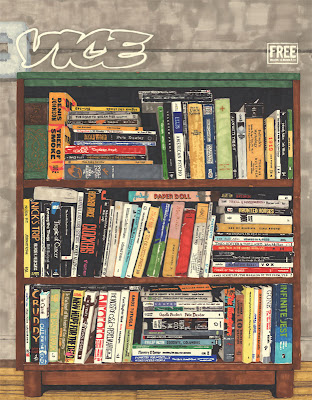
And I was pretty excited when I found this recent Fiction issue of Vice, with every page dedicated to new writing.


However, words don't always comes all that easily for people. It takes time and effort and discipline, as well as creativity and flair and ideas. And that even goes for some of the most prolific writers, as Stephen Fry explained in what will be his last blog post for a little while.

For me, writing isn't always easy, but it is important. In a previous post, I wrote about how they say a picture is worth a thousand words, but a single word can start ten thousand stories. That said, not too many of them start Yeah no but.

Friday, November 6, 2009

How does it feel to feel?

My Friday afternoon took a rather sinister turn after a fight broke out at Melbourne airport.

A couple of guys walked through the terminal, found their man, and then came a violent eruption of punches until a couple of brave passengers stood between them. The attackers checked themselves, uttered a few choice words about broken noses, and then turned and traced their steps back through the airport.

It was all over quite quickly, but the emotion in the air was intense.

Admiration for the brave men who had put themselves in the middle of the melee, and stopped the fight from going any further. Fear from the female Qantas ground staff who found themselves in the thick of it as the fight spilled behind the customer service desk. And a mixture of anxiety, shock and excitement swirled around the scene, along with pretty much every other emotion you care to name.

And it reminded me of just how emotionally charged we are – as a species, I mean.

Yes, granted we spend a great deal of time thinking – "Cogito ergo sum", as Descartes once famously pronounced – but so much of our existence also relies upon our capacity to feel.

Earlier this week, Adam Ferrier wrote in his blog, Consumer Psychologist, about the Melbourne Cup, gambling and the concept of variable positive reinforcement – the practice of rewarding desired behaviour (for example, gambling) at random times and with random amounts. And he wondered why marketers didn't use this concept more often and not just in promotions, under the pretext that, "If it's the strongest conditioner of human behaviour, shouldn't marketers be trying to understand it and applying its principles in a slightly more sophisticated way"?

Again, what Adam is raising here is the very visceral nature of the human race – ideas that relate to our deepest inward feelings rather than to our intellect.

The automotive industry, for one, has always worked hard on designing a human feel to its cars. Not simply when it comes to how they function, but also how they look. In fact, most cars smile.


If you look at the VW Beetle or the new model Mazda 3 (just to name a couple), the bonnet, grille and headlights are often designed and positioned to mirror a human face. And a happy one at that.

At the opposite end of the scale to happiness is loss – specifically death, in the form of cult brand, Death Cigarettes.


Here's some of the on-pack copy:

A pack of Death cigarettes leaves no doubt as to the risks of smoking. We don't print a health warning just because it's law. We believe in telling the truth...a responsible way to market a legally available consumer product which kills people when used exactly as intended.

You couldn't get a more honest smoke.

As humans, we are a complex race full of raw emotion and feeling. They say the truth hurts, and they're right. But not because it's true in thought, more so because it hurts our feelings.

So it is, that the most successful brands are often also the most primal. And if you ask me, that feels just about right.